19.12.25
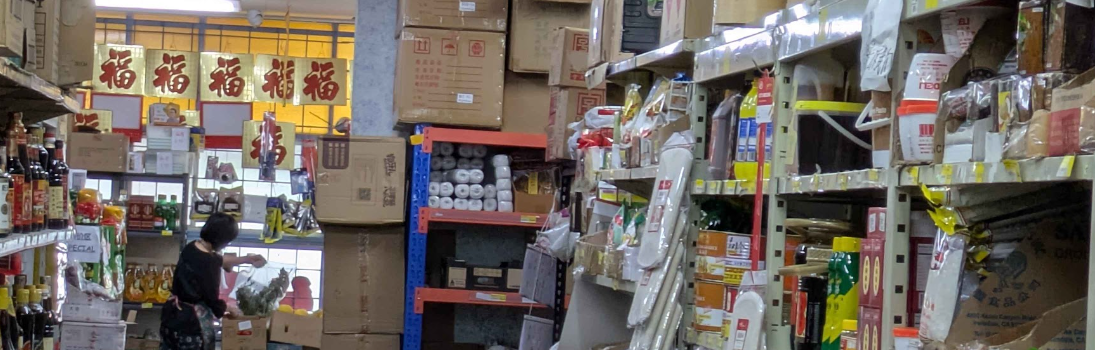
Crammed and tight— constricting even, with a very distinct fragrance of packaging plastic, a vague incense, and partially corroded metal that is hard to pinpoint the location of. A sense of home follows me through the store as much as thoughts eat away at my conscience; the embarrassment of trying to find the translations of names and products I’m looking for. I pull out my phone to translate, as if it were a beacon signalling that I don’t belong here to every native speaker in a fifty meter radius. But there is a distinct lack of eyes on me. Despite towering over the tallest stocked shelves in this repurposed front of a store, where every cent of property is used, and even in meeting with the dusty overstocks not meant for eyes— I can’t distinguish if my invisibility is born of others’ fear, my insecurity, or a total acceptance that even I cannot see between plastic bags of imported staples.
Pointless ramps and elevations are everywhere in this labyrinth and likely left over from the building’s past life, as if now their purpose is to force you to brush shoulders with one-another and squeeze through a pile of woks and tightly-packed produce shelves apologetically so you trip and lean in a forced ritual grocery-dance. But my feet can’t find the rhythm etched into this place, and I cannot help but bump into someone— unsuccessful in shrinking myself to an adequate size. I notice a yellow fruit dropped on the ground too, next to a younger woman in an apron as sweat drops off of her brow in tandem with her arms reaching out to rest the box that the fruit must’ve fallen out of. Something tangs as another thing falls out her pocket when she rests the box, which she goes to grab before it rolls away, and I try to find a little place for the singular fruit amidst the balancing act of others.
An older woman also reaches all the way down to the floor, throwing a bag of staples too heavy for creaking shelves, but not for them as it goes to rest on their forearms. Without grievance or disdain for the organisation of items they carry it across the flowing traffic of people and their groceries. There is a warmth in hearing people speak a non-English language so proudly and loudly and I always think about properly learning some common phrases to settle a foreign discomfort, but can never find the courage to speak their words through the guilt of being in a place not made for me. A place made as a sanctuary for those away from home, a sanctuary and community that I, too, never quite had growing up. A shield from Western commercialism where ‘Asian’ encompasses a single aisle combining Hispanic, Chinese, Korean, and Japanese products half of which are approximations at best and produced by Western companies with ‘ingredients that can be pronounced’. I want to share that I understand this place in ways that aren’t apparent— that I could never find a taste of home from my country now enshadowed by war that I too can no longer visit— with parents that are no longer in my city. I’m not sure where I can find квас (kvass) anymore, or the зефиры (zefirs) I’d pretend to not know were hidden behind the box of matches on the top pantry shelf, nor the bowls of оливье (olivier) that at potlucks that would have their servings doubled just for me because my mum knew I’d be upset otherwise. But some things I realise cannot be communicated by a brief smile from a white person that looks like they belong everywhere else but this sanctuary. In moving through this space, I find an odd comfort in my lack of place knowing that there, atleast in the smallest pockets of my new home, are still homes being made for those who miss theirs.
author's note
Tasting Home is the writing of a personal experience, walking through a local Asian grocer near the apartment I recently moved into as an [immigrant]. The experience of narrow aisles and people finding traces of their community in a vast city of Western influence and development, there is a contemplation of the spaces that communities build as a way to hold onto important cultural anchors like food and language. The piece grieves the absence of these spaces for others and serves as an invitation to the reader to reflect on their own cultural spaces and the importance to their local community.
--
above is the actual context statement, but more personally, this piece represents a bit to me as it's probably one of my most 'outwardly' meditative pieces, meaning that a lot of my pieces are usually caught up in my thoughts and complex feelings whereas this piece was an attempt to sit with the interactions between my experiences and the spaces around me. the tone shift is very clear and this was a really enjoyable albeit stressful piece to write as now i'm representing more than just myself, and have to make sure i'm treating the spaces i'm writing about with the sensitivity and care they deserve. this also, very importantly, is perhaps my first published piece! so it's very nice to have a marker in my adult writing so i can look back on something polished and compare myself to it later :)